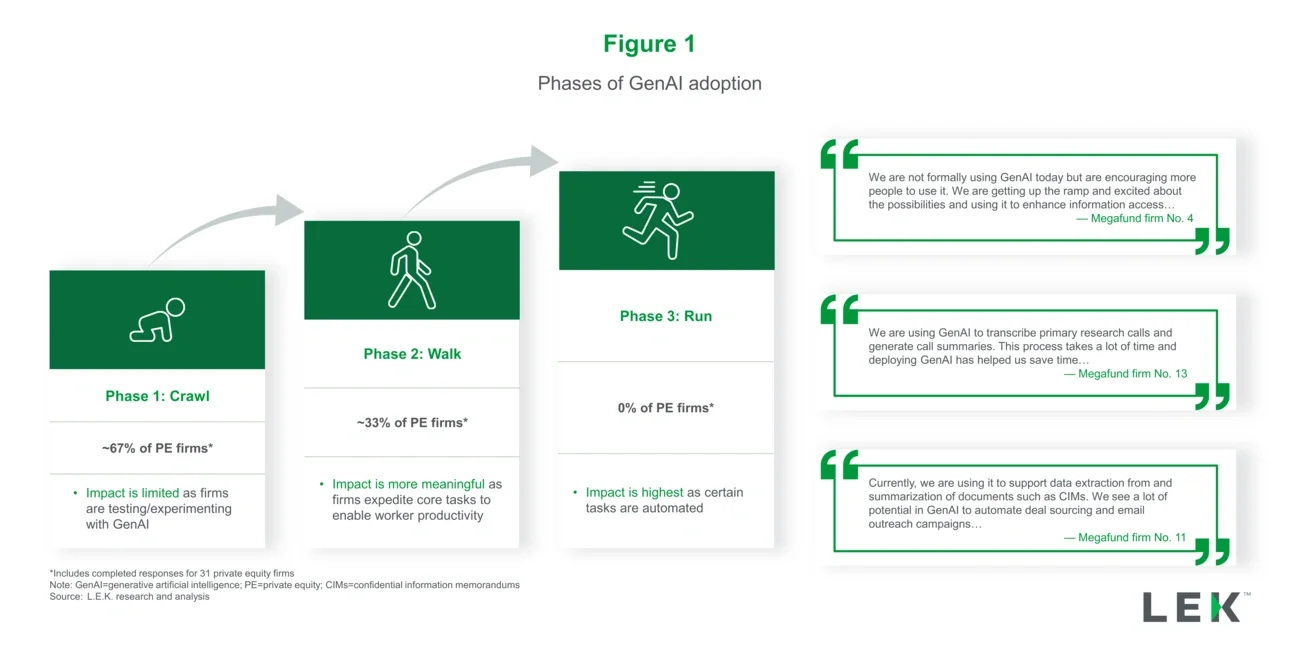
Phase 1: Initial exploration
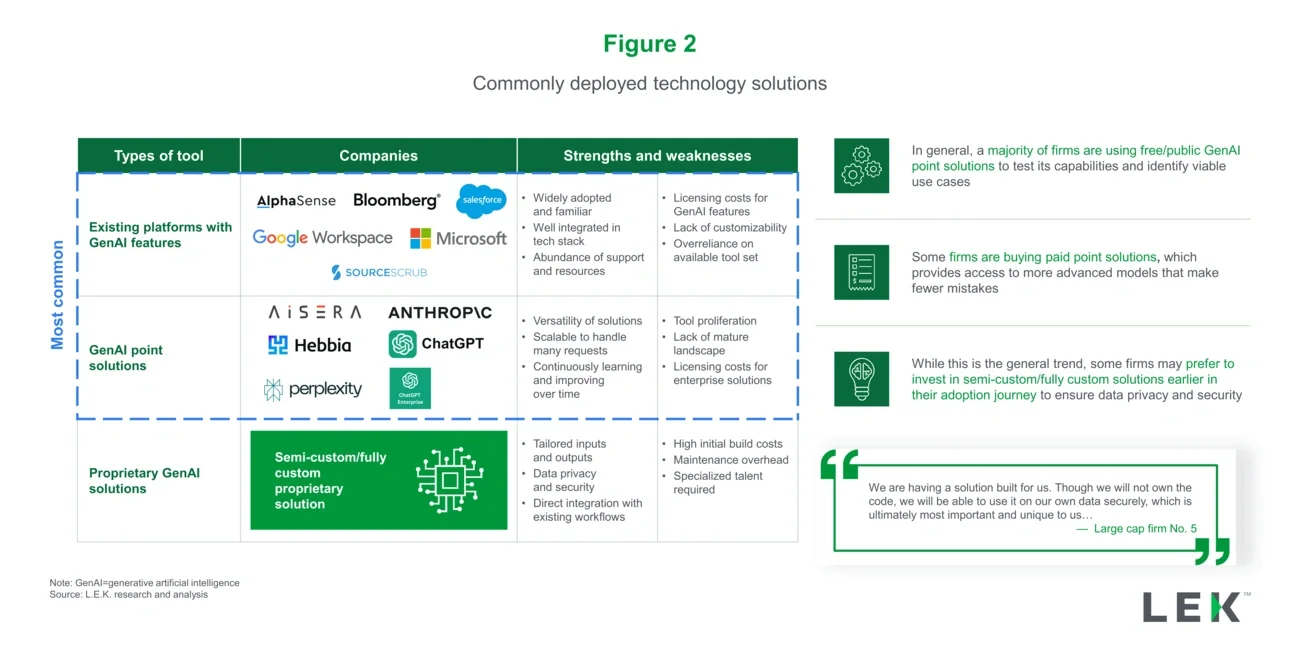
In this phase, firms focus on aligning their GenAI strategies and experimenting with high-volume, low-risk applications like summarizing investment memos, drafting interview guides, creating competitor lists, personalizing recruitment emails and summarizing expert call notes. Key actions in this phase include forming strategy committees, educating employees and using public tools like OpenAI’s ChatGPT, Google’s Gemini and Perplexity AI within defined data use policies.
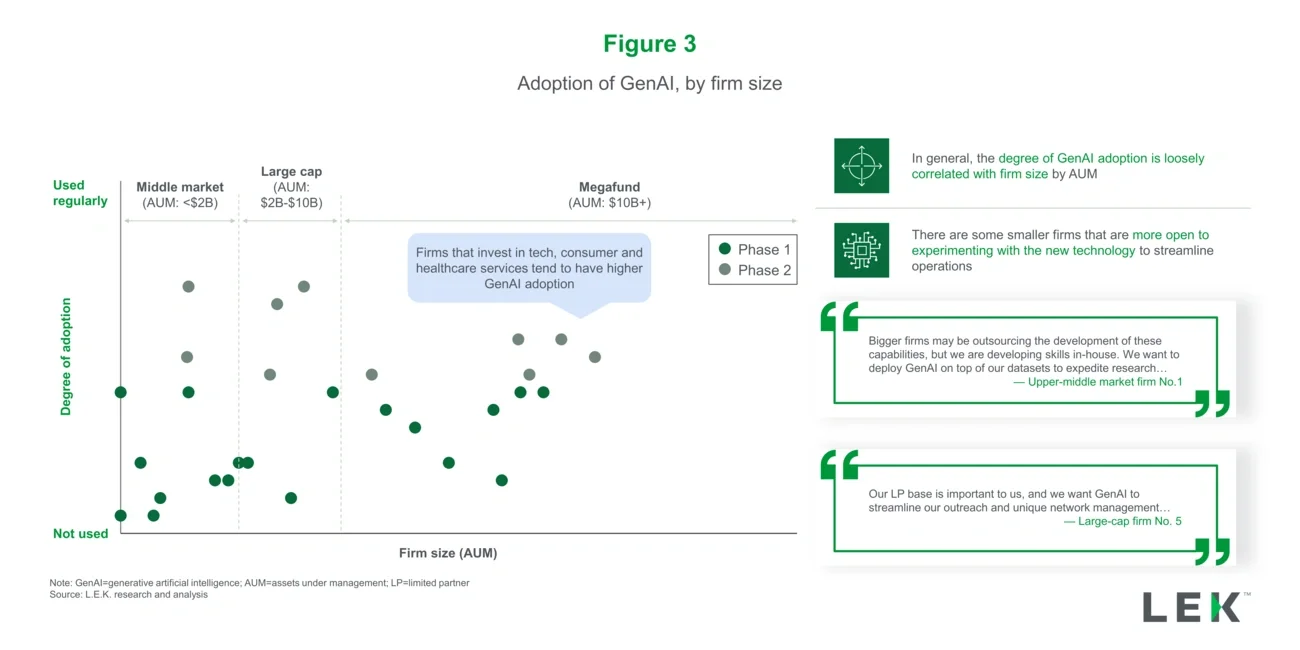
Phase 1 firms usually tap into their existing staff for GenAI initiatives, favoring internal skills enhancement over new specialized hires. Current team members often take on GenAI adoption and blend it with their existing responsibilities, exploring its potential through self-education and experimentation with public tools.
“We are using GenAI to transcribe primary research calls and generate call summaries. This process takes a lot of time and deploying GenAI has helped us save time.”
— Senior Partner, Megafund
Phases 2 and 3: Enhancing productivity
Around 33% of surveyed firms have evolved to phase 2, where activity and investment are more meaningful as firms leverage GenAI to expedite an expanded set of tasks to enable worker productivity. Examples in this stage include integrating proprietary deal or firm data to supplement public research, extracting and summarizing data from deal rooms, and automating industry updates.
As firms advance to phases 2 and 3, the demand for dedicated talent becomes more evident, but firms don’t typically rush to hire AI-specific experts such as AI developers. Instead, they prioritize the specialized skills of existing staff, such as software engineers, to integrate GenAI into their workflows. This strategy helps assess the existing resource gaps that GenAI can address. This approach also aids in forecasting the evolution and complexity of future use cases, ensuring that the timing and scale of hiring align with their expansion goals.
The GenAI tools utilized in these phases vary but often involve integrating general purpose foundational models with other systems to address specific needs. While many out-of-the-box tools like Hebbia can search for information, advanced firms are also developing customized solutions to optimize workflows, often still leveraging underlying large language models from providers like OpenAI and Anthropic. Examples include:
- Automating aspects of limited partner outreach by integrating Anthropic into existing customer relationship management (CRM) systems
- Expediting elements of deal sourcing by using ChatGPT Premium or Anthropic for sentiment analysis of targets and scoring based on predefined metrics
- Supporting due diligence processes by using ChatGPT Premium or private deployments of Azure OpenAI to summarize confidential information memorandums and synthesize findings