Scaling hinges on data readiness and process integration
AI expansion brings operational constraints. Survey respondents identify three barriers more often than others: data quality limitations, workflow integration challenges, and governance gaps around ownership and oversight. These issues appear across both utilities and oil and gas firms.
Implementation difficulties are cited most frequently, with more than one-quarter calling them the clearest bottleneck. Executives describe cases where model accuracy is strong but integration into existing workflows remains incomplete. Others highlight inconsistent data availability or insufficient feedback loops for model refinement. These challenges limit AI’s reliability in production environments.
Importantly, these constraints are less about the underlying technology and more about organizational readiness. As seen across other asset-intensive industries, the majority of AI value creation depends on process integration, data quality and operating-model alignment rather than model performance alone. Without clear ownership, redesigned workflows and consistent governance, even technically robust AI solutions struggle to deliver repeatable impact at scale.
Companies are addressing these issues through infrastructure upgrades and more structured approaches to deployment. More than half identify IT system modernization and data platform improvements as top priorities. Many are also advancing initiatives to clarify governance, improve data hygiene, and ensure alignment between digital teams and operational leaders.
The study’s interviews reinforce this picture, as leaders point to a real need for standardized inputs and clearer accountability. These steps determine whether AI contributes consistently to operational or commercial results.
Return on investment remains difficult to capture, yet long-term confidence is strong
Executives express a mix of caution and confidence when evaluating AI’s current value. Some rely on AI in limited settings, while others apply it broadly yet struggle to quantify the impact. Data fragmentation and incomplete integration are some of the biggest roadblocks which continue to inhibit performance.
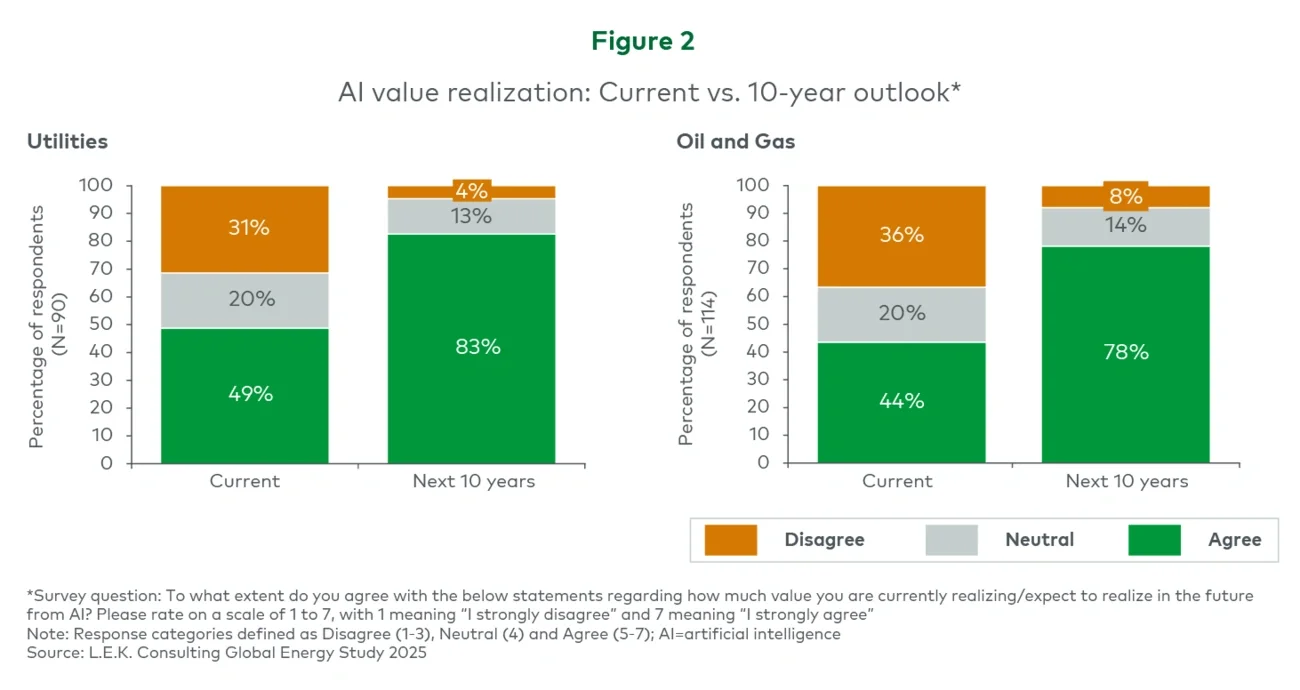
The long-term view is markedly more optimistic than the current assessment. While only 49% of utilities and 44% of O&G respondents believe their organizations are fully realizing AI’s value today, that figure rises to 83% and 78%, respectively, when looking ahead 10 years. This gap highlights a consistent pattern across the sector: Leaders recognize that meaningful value has yet to be captured at scale, but remain confident that the underlying opportunity is substantial (see Figure 2).