Executive Insights

How Sports Fandom Is Evolving in 2025: Insights From L.E.K.’s Annual Sports Survey

June 24, 2025

Key takeaways

Women’s sports are experiencing unprecedented growth, with the WNBA leading all leagues at a 65% year-over-year increase in avid fandom and star athletes like Caitlin Clark driving viewership increases of over 160%.

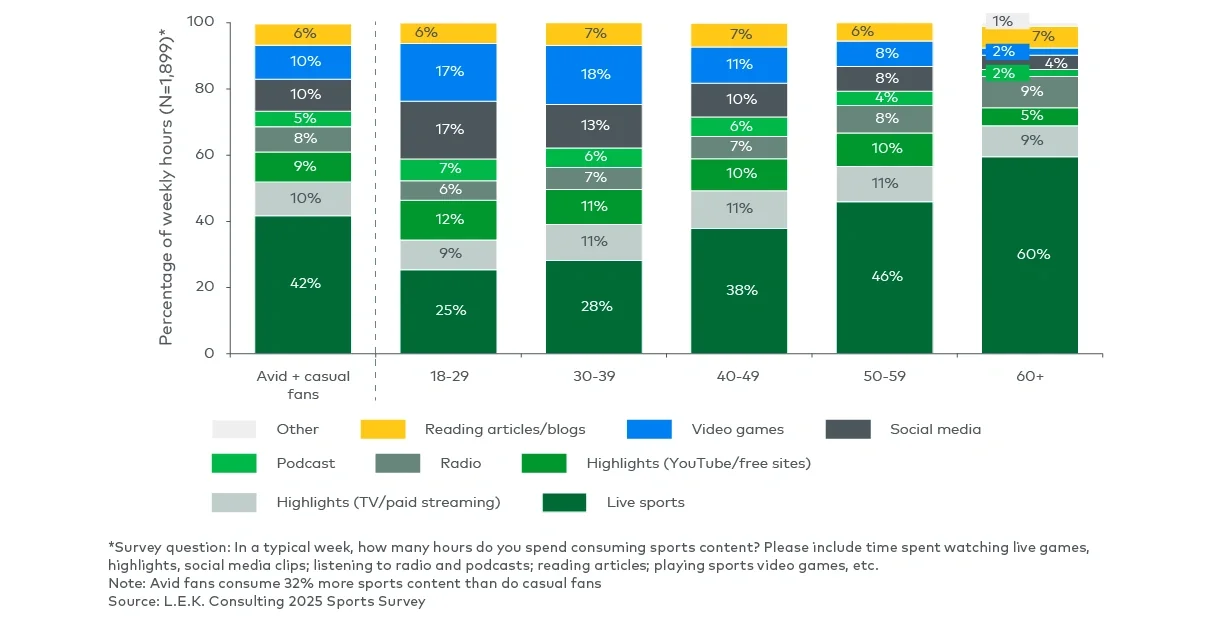
A significant generational divide exists in sports media consumption, with fans ages 18-29 allocating just 25% of their time to live sports content compared to 60% for fans over 60, signaling a shift toward highlights, social media clips and video games. 

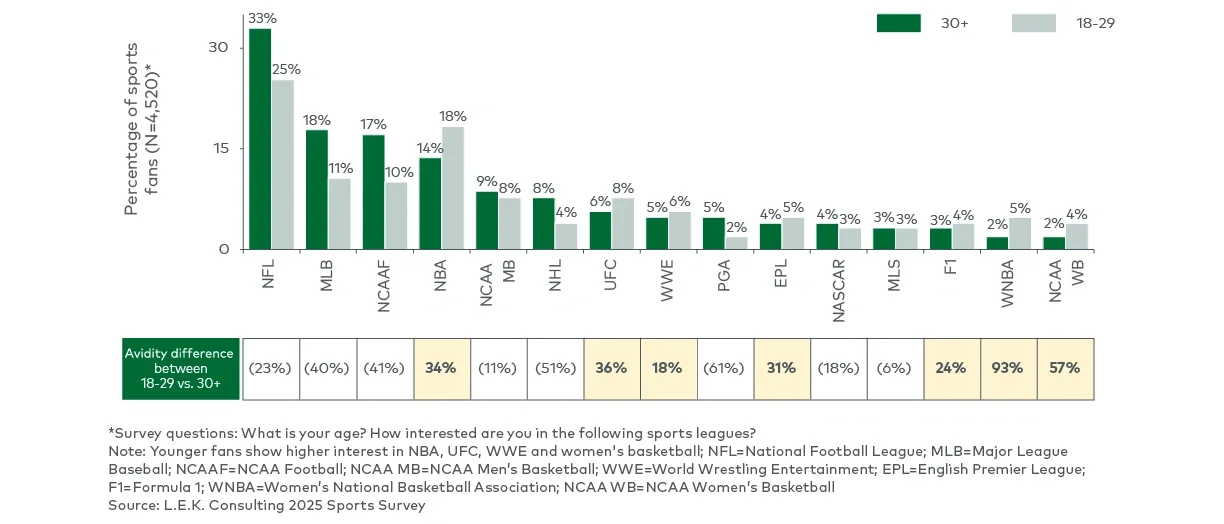
League preferences vary significantly across age groups. Younger fans show stronger interest in the NBA, UFC and women’s sports, while sports like MLB, college football and the PGA exhibit lower avid fan incidence among fans ages 18-29 compared to those over 30.

MLS continues to face strategic challenges despite its role as the top U.S. soccer league, with 68% of avid pro soccer fans preferring international leagues, alongside limited traction for its exclusive streaming model among casual viewers. 

Introduction

Sports fandom in America continues to evolve in response to changing demographics, media fragmentation and shifting cultural preferences. To capture these dynamics, L.E.K. Consulting conducted its annual Sports Survey in January 2025, gathering insights from 4,520 U.S.-based adults who serve as primary decision-makers for media purchases in their households. Respondents evaluated over 20 professional and collegiate sports leagues across more than 50 distinct metrics.

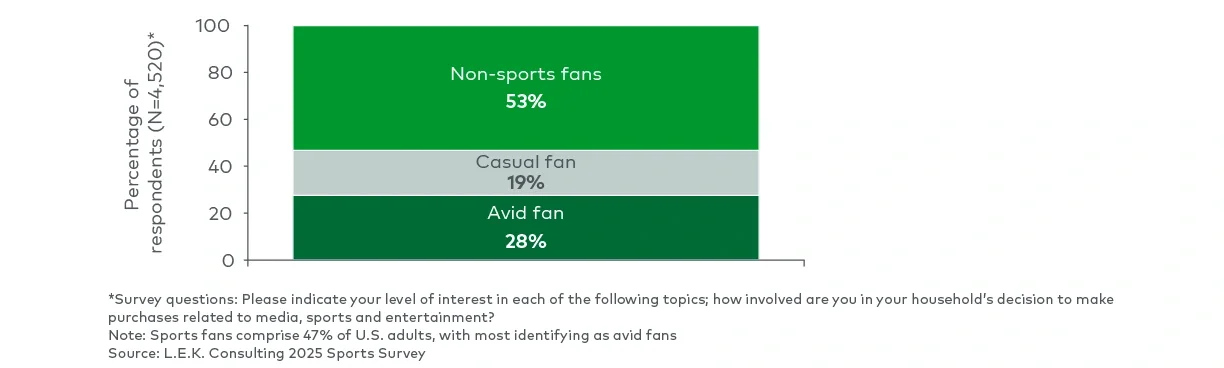
The data reveals that 47% of respondents identify as sports fans, with 28% describing themselves as avid fans and 19% as casual followers. The NFL stands out as the most popular league, with approximately 32% of survey respondents identifying as avid NFL fans — significantly higher than MLB (17%), college football (16%) and the NBA (14%) (see Figure 1). 

Figure 1

Interest in traditional sports (Dec. 2023, Jan. 2025)

Image
Interest in traditional sports (Dec. 2023, Jan. 2025)

Figure 1

Interest in traditional sports (Dec. 2023, Jan. 2025)

Image
Interest in traditional sports (Dec. 2023, Jan. 2025)

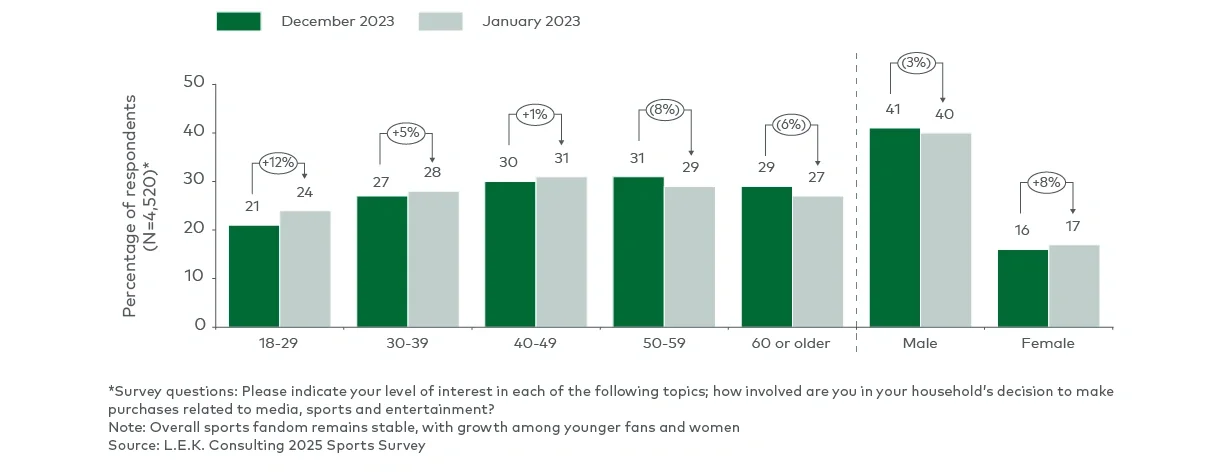
Even though overall sports fandom remained stable year over year, our demographic analysis uncovered important shifts in the composition of the fan base. Notably, younger adults under 30 showed a 12% increase in interest compared to last year, and women saw an 8% increase in sports engagement, suggesting a generational and demographic transformation in who is following sports (see Figure 2).

Figure 2

Change in avid interest in traditional sports, by age group and gender

Image
Change in avid interest in traditional sports, by age group and gender

Figure 2

Change in avid interest in traditional sports, by age group and gender

Image
Change in avid interest in traditional sports, by age group and gender

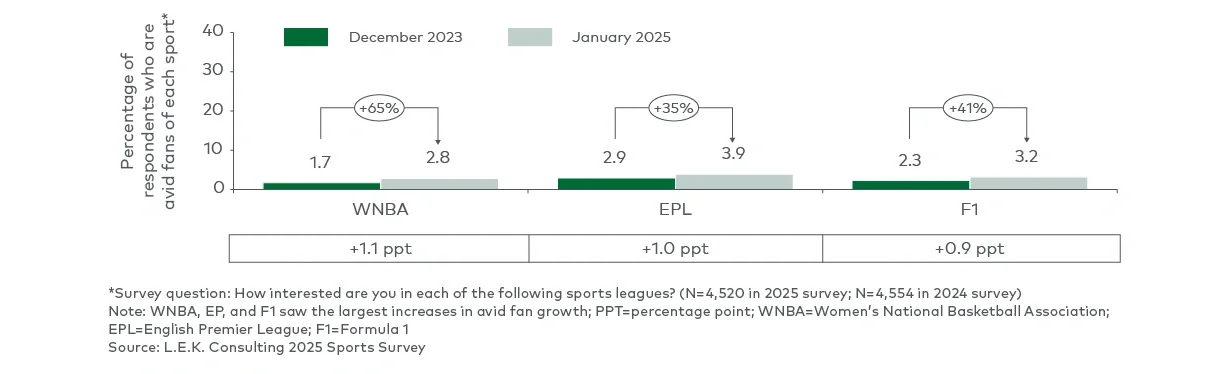
These demographic changes coincide with shifting league fortunes. Our analysis identified clear winners and losers in the competition for fan attention, with certain properties experiencing substantial growth and some traditional powerhouses facing declining interest. The Women’s National Basketball Association (WNBA) led all leagues with a remarkable 65% year-over-year growth in avid fandom, followed by the English Premier League (35%) and Formula 1 (F1) (41%). 

Conversely, men’s college basketball saw an 18% drop in avid fandom, followed by an 11% decline for college football and an 8% decrease for the NHL — representing millions of lost fans across these established leagues (see Figure 3). 

Figure 3

Top three largest percentage point increase in avid fan incidence (December 2023-January 2025)

Image
Top three largest percentage point increase in avid fan incidence (December 2023-January 2025)

Figure 3

Top three largest percentage point increase in avid fan incidence (December 2023-January 2025)

Image
Top three largest percentage point increase in avid fan incidence (December 2023-January 2025)

Women’s sports experience breakthrough momentum

The advance of women’s sports has moved beyond incremental growth to meaningful market impact. The WNBA’s 65% increase in avid fandom leads all leagues in growth, indicating a significant shift in the marketplace.

The survey asked interested fans to identify key drivers of their interest in women’s sports. Top reasons included the quality of play (25%), to support equal opportunities for women athletes (24%), strong role models (23%) and general sports fandom (22%). Female fans were especially likely to cite strong role models (33%), but male fans most often pointed to the quality of play (27%) and interest in sports more broadly (25%).

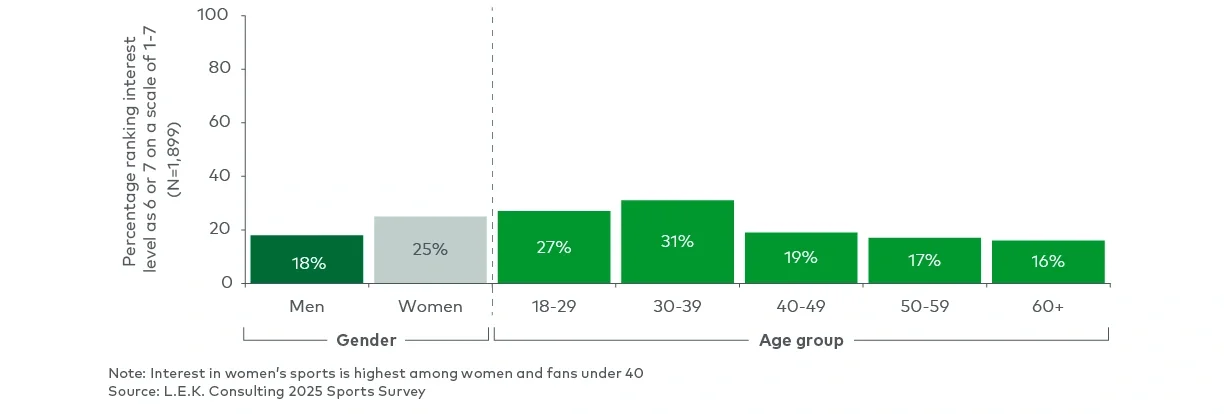
Interest in women’s sports is strongest among women and younger fans, creating a favorable demographic tailwind. While still a subset of the broader fan base, this engagement is broad-based and signals a healthy foundation for future growth (see Figure 4). 

Figure 4

Interest in women’s sports

Image
Interest in women’s sports

Figure 4

Interest in women’s sports

Image
Interest in women’s sports

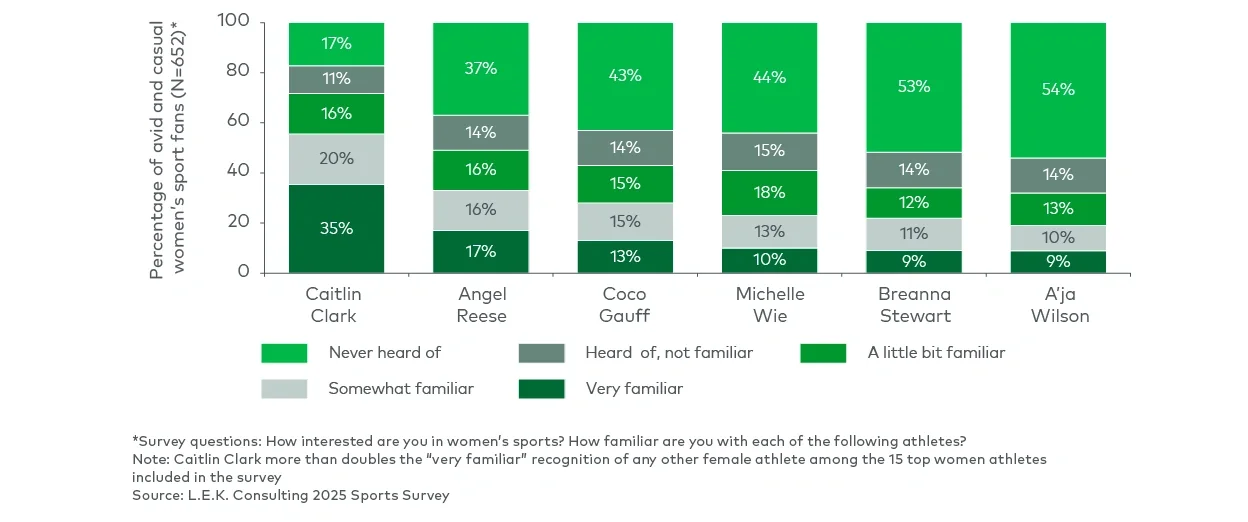
This momentum has translated into major media rights deals. The WNBA’s annual value jumped to $200 million, and the National Women’s Soccer League (NWSL) grew from $1.5 million to $60 million. The “Caitlin Clark effect” exemplifies this transformation. Her exceptional recognition among fans helped drive a 161% WNBA viewership increase, showing how transcendent stars can reshape league economics (see Figure 5). 

Figure 5

Familiarity with women athletes

Image
Familiarity with women athletes

Figure 5

Familiarity with women athletes

Image
Familiarity with women athletes

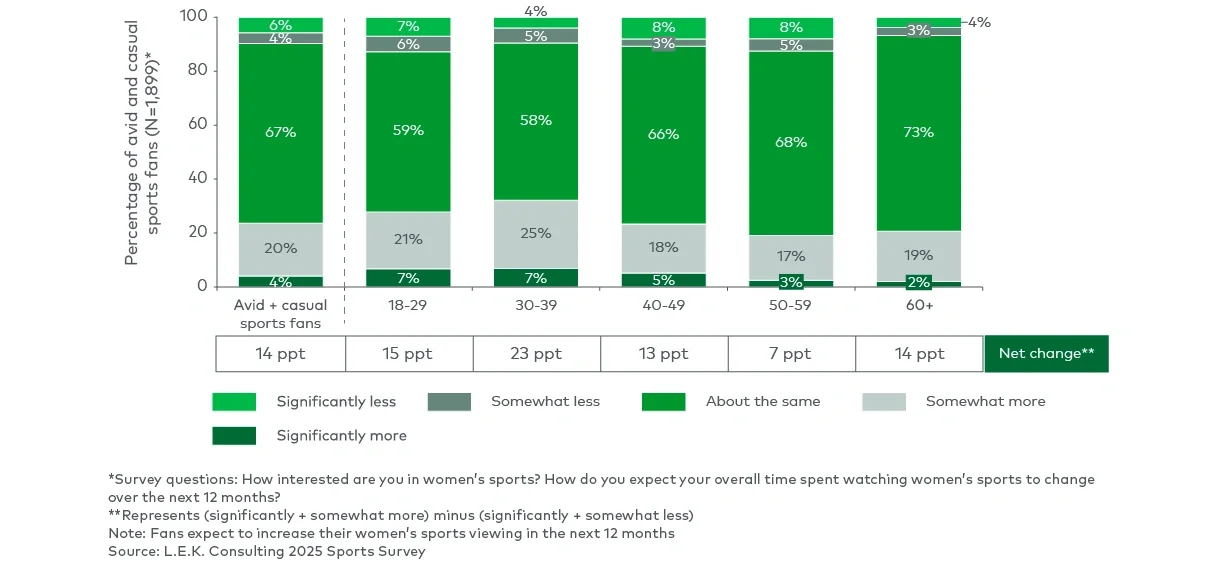
Looking ahead, fans expect their engagement with women’s sports to increase. The survey shows a positive 14% net change in expected viewing time for women’s sports over the next 12 months, with the strongest growth anticipated among fans ages 30-39. Even among older fans and casual viewers, the forecast remains positive (see Figure 6). 

Figure 6

Expected change in time watching women’s sports over the next 12 months

Image
Expected change in time watching women’s sports over the next 12 months

Figure 6

Expected change in time watching women’s sports over the next 12 months

Image
Expected change in time watching women’s sports over the next 12 months

Soccer’s complex position in the US

This demographic stability seen in women’s sports offers an interesting contrast to soccer’s more fragmented position in the American sports landscape. While women’s sports demonstrate consistent growth across age groups, soccer in the U.S. presents a more complex picture, with stark divisions between casual and avid fans. The NWSL has benefited from the broader women’s sports momentum, but men’s soccer displays a different pattern altogether.

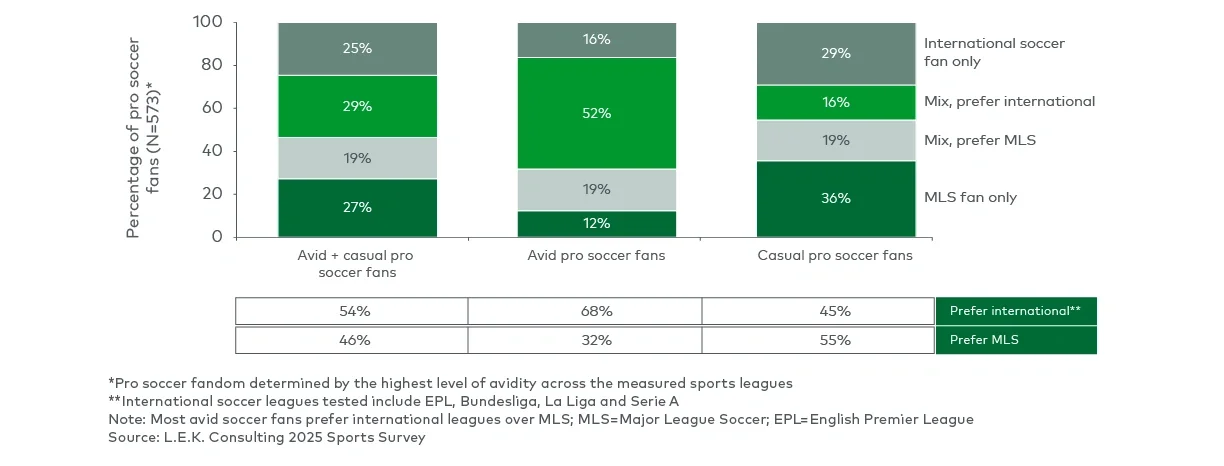
MLS holds the top spot for overall popularity among U.S. soccer leagues, with 3% of sports fans identifying as avid MLS fans and 10% as casual fans. However, among dedicated soccer enthusiasts, international leagues command greater allegiance.

The survey reveals that 68% of avid soccer fans prefer international leagues, with the English Premier League (EPL) leading the pack. This preference for international soccer is most pronounced among the most engaged fans, but casual soccer fans still favor MLS by a 55% majority (see Figure 7). 

Figure 7

Interest in MLS vs. international soccer leagues (January 2025)

Image
Interest in MLS vs. international soccer leagues (January 2025)

Figure 7

Interest in MLS vs. international soccer leagues (January 2025)

Image
Interest in MLS vs. international soccer leagues (January 2025)

When analyzing preference drivers, clear distinctions emerge between fans of different leagues. MLS fans primarily value local team support and star power (such as Lionel Messi), while EPL enthusiasts overwhelmingly cite the higher quality of play (46%), global star power (26%) and prestigious club history (24%). This highlights MLS’ central challenge: Despite attracting major stars, it still trails international leagues in perceived quality, particularly among avid fans.

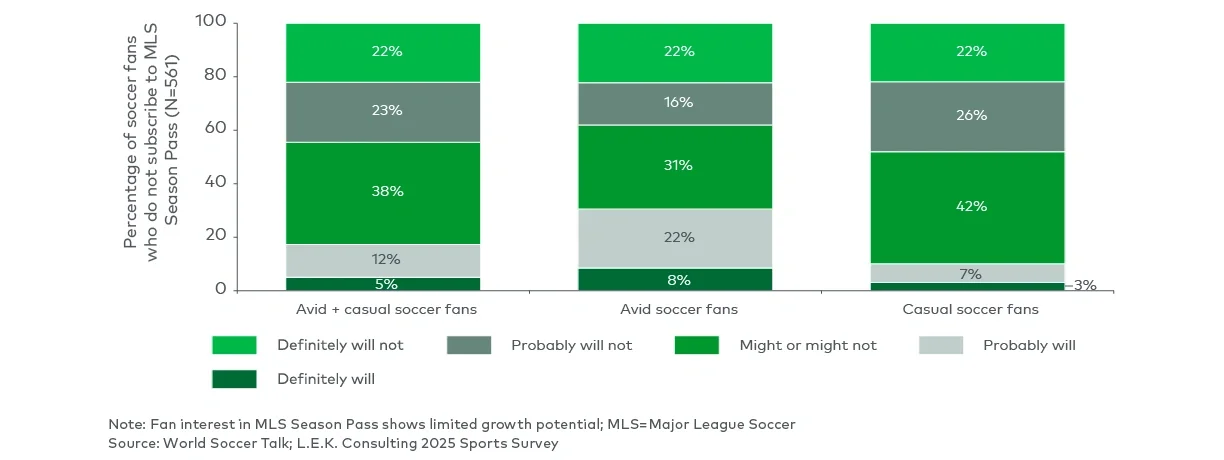
Despite early promise, MLS Season Pass adoption has seemingly stalled after initially reaching 2 million subscribers. The exclusive streaming model with Apple has raised accessibility concerns, which may be contributing to the significant viewership declines of MLS linear TV broadcasts, including the MLS Cup. Our survey data suggests MLS may risk losing relevance among the broader sports fan base, with limited subscription interest among nonsubscribers (see Figure 8). 

Figure 8

Likelihood to subscribe to MLS Season Pass next season

Image
Likelihood to subscribe to MLS Season Pass next season

Figure 8

Likelihood to subscribe to MLS Season Pass next season

Image
Likelihood to subscribe to MLS Season Pass next season

A changing media rights landscape

As fan preferences shift, so too does the business model supporting them. In a recent edition of Executive Insights titled “The Streaming War for National Sports Rights,” we explored the competitive dynamics of streaming platforms vying for premium sports content. Streamers are expected to invest $7.1 billion in national sports rights in 2025, up from $3.9 billion two years ago.

The draw? Live events consistently drive subscriber growth and advertising revenue, particularly among younger demographics that otherwise split their attention across TikTok, YouTube and gaming.

Our 2025 Sports Survey examined this dynamic through targeted questions about platform preferences and viewing habits. The data reveals that 46% of ESPN+ subscribers consider sports content “very important” to their subscription decision; however, fans ages 18-29 spend just 25% of their sports viewing time watching live sports content compared to 60% for fans over 60.

Although the women’s sports surge highlighted previously in this report is one outcome of this competitive environment, properties like UFC and F1 are also leveraging their unique audience demographics into stronger negotiating positions. Meanwhile, the regional sports network model faces existential challenges with the Diamond Sports/Main Street Sports Group bankruptcy proceedings — a topic we’ll explore in our next Executive Insights focused on the local media landscape.

Evolving fandom and shifting consumption

These changes in media rights reflect broader transformations in how fans engage with sports content. The 2025 Sports Survey underscores fundamental shifts in fan engagement. Avid sports fans consume approximately 32% more weekly sports content than do casual fans (20.5 hours versus 14.5 hours), but younger audiences are dramatically reshaping where and how that content gets consumed (see Figure 9). 

Figure 9

Average weekly per person hours consuming sports content among avid and casual sports fans, by age group (January 2025)

Image
Average weekly per person hours consuming sports content among avid and casual sports fans, by age group (January 2025)

Figure 9

Average weekly per person hours consuming sports content among avid and casual sports fans, by age group (January 2025)

Image
Average weekly per person hours consuming sports content among avid and casual sports fans, by age group (January 2025)

In addition to shifting platform preferences, total time spent consuming sports content is increasing. The 2025 Sports Survey shows that weekly viewership is rising across all age groups, with younger fans driving the most significant growth. Among fans ages 18-29, 39% reported watching more sports content than last year — a net increase of 23%, the highest of any age group. This growth is fueled largely by short-form content, social media and gaming — channels that reflect broader shifts in how sports content is consumed.

Age-based differences in media consumption are stark. Younger fans tend to prefer social media, gaming and on-demand formats over traditional live broadcasts; older audiences still dedicate the majority of their viewing time to live sports events.

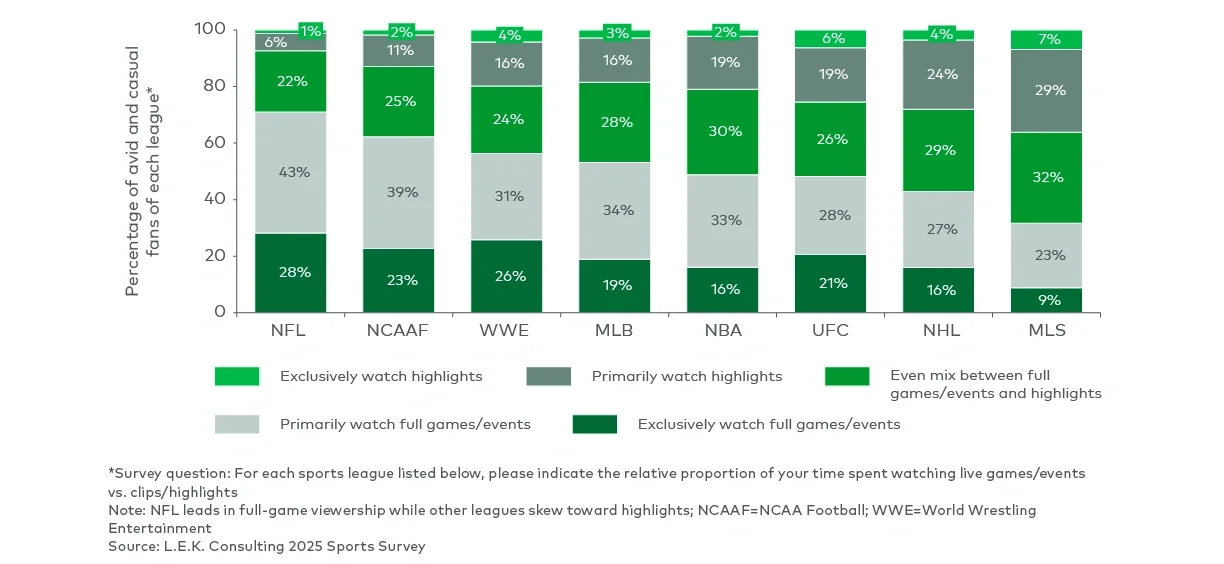
This fragmentation extends to viewing habits as well. NFL fans lead in full-game viewership, with 71% of fans primarily or exclusively watching full games. In contrast, only 32% of MLS fans fall into that category, with most favoring highlights or a mix of formats.  

Age further shapes these preferences. Younger fans (ages 18-39) are significantly less likely than are older fans (40+) to primarily or exclusively watch full games. The largest gaps between the two age groups appear in World Wrestling Entertainment (18 percentage points), MLB (17 percentage points), and NCAA football and NHL (13 percentage points each), highlighting a generational shift toward highlight-driven formats (see Figure 10). 

Figure 10

Watching preferences, by sports league

Image
Watching preferences, by sports league

Figure 10

Watching preferences, by sports league

Image
Watching preferences, by sports league

Most notable is the stark contrast in league preferences between age groups. The NFL remains the most popular league across all demographics, but its avid fan incidence is 8 percentage points lower among fans ages 18-29 compared to those over 30. In contrast, younger fans show higher levels of avidity for leagues like the NBA (18% among 18-29 versus 14% among 30+), UFC (8% versus 6%) and WNBA (5% versus 2%).  

These differences suggest that leagues with stronger digital engagement and social media presence are resonating more with the next generation of fans (see Figure 11). 

Figure 11

Avid fan incidence by sport (top 15 sports by avid incidence), age 18-29 vs. 30+ (January 2025) 

Image
Avid fan incidence by sport (top 15 sports by avid incidence), age 18-29 vs. 30+ (January 2025)

Figure 11

Avid fan incidence by sport (top 15 sports by avid incidence), age 18-29 vs. 30+ (January 2025) 

Image
Avid fan incidence by sport (top 15 sports by avid incidence), age 18-29 vs. 30+ (January 2025)

Meeting the next generation of fans

These evolving consumption patterns, combined with changing demographics and media landscapes, point to a future that’s more diverse, more digital and more fragmented. The growth of women’s sports, the rise of global leagues like EPL and F1, and the expanding definition of engagement are all reshaping what it means to be a sports fan.

To remain relevant, leagues and media partners must adapt by delivering shorter formats optimized for digital platforms, creating interactive social media touchpoints and developing mobile-first engagement strategies that complement traditional broadcasts. Properties that invest in star development, particularly among female athletes, stand to gain significant ground with the next generation. Our data clearly shows that the next generation isn’t abandoning sports; they’re simply engaging on their own terms.

About L.E.K. Consulting’s Sports practice

L.E.K. Consulting brings 40+ years of strategy experience to the sports industry. Our dedicated Sports practice works with leagues, broadcasters and platforms to deliver actionable strategies in media rights, audience segmentation and digital transformation. With a global team of 2,200+ professionals across 22 offices, we provide the analytical rigor needed to navigate industry shifts — from the surge in women’s sports to changing media consumption patterns.

For more detailed insights or to discuss how these findings might impact your organization, please contact us.

L.E.K. Consulting is a registered trademark of L.E.K. Consulting LLC. All other products and brands mentioned in this document are properties of their respective owners. © 2025 L.E.K. Consulting LLC 

Questions about our latest thinking?

English