Executive Insights

How Pharma Companies Are Driving the Next Wave of Revenue Growth

June 25, 2025

Key takeaways

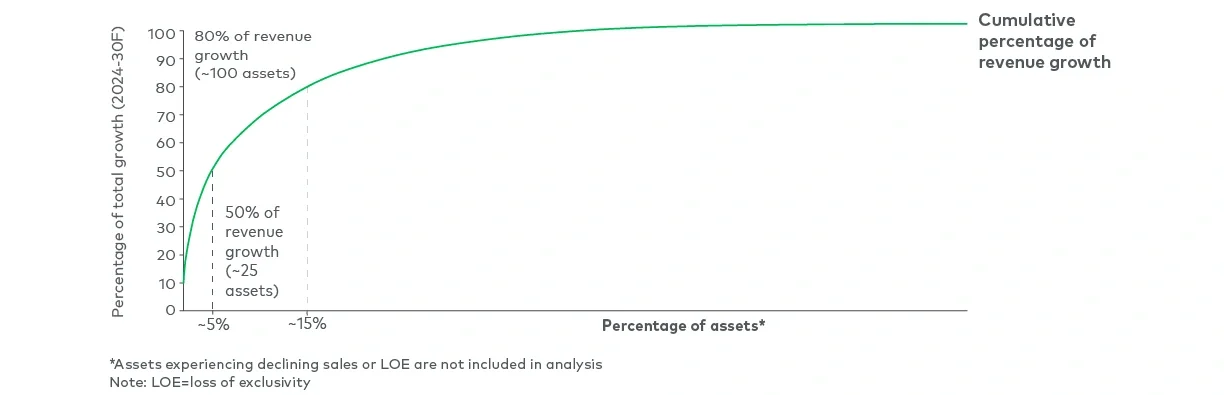
Future revenue growth among the top 15 biopharma companies is expected to be highly concentrated, with approximately 100 key assets projected to drive 80% of the $200 billion in incremental revenue between 2024 and 2030.  

Multi-disease assets are delivering outsized impact relative to their portfolio share, reinforcing the strategic benefit of prioritizing these over single-indication therapies.  

Around 70% of this growth will come from in-line products already on the market, highlighting the importance of lifecycle optimization, indication expansion, and disciplined launch execution as levers for sustained value creation.  

The majority of growth will come from core therapeutic areas where companies have existing scale and capabilities, underscoring the competitive advantage of therapeutic depth over diversification.  


While internal R&D remains essential, external innovation through business development and seamless deal integration will play an increasingly critical role in driving revenue growth.  

Introduction

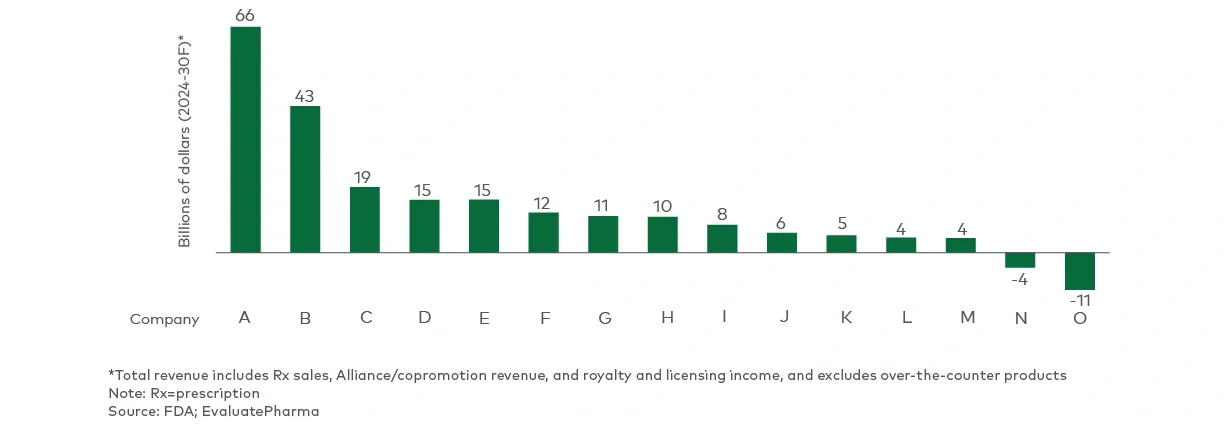
The top 15 biopharma companies account for 75% of total industry revenue, making their future performance a defining factor for the sector at large. Their strategies, investment decisions and execution disproportionately shape the trajectory of innovation and the creation of shareholder value across the entire sector. Despite facing loss of exclusivity (LOE) risks impacting 25%-30% of 2024 revenue, these companies are projected to grow their combined revenue by approximately $200 billion — a 30% increase — by 2030 (see Figure 1). 

Figure 1

Top 15 biopharma revenue growth (2024-30F) 

Image
Top 15 biopharma revenue growth (2024-30F)

Figure 1

Top 15 biopharma revenue growth (2024-30F) 

Image
Top 15 biopharma revenue growth (2024-30F)

Yet this growth is highly uneven. Nearly 80% of the projected revenue expansion is expected to come from just five companies, highlighting the growing divide between market leaders and the rest of the industry.

As executive teams navigate where and how to invest, a clear understanding of the underlying growth drivers — ranging from asset concentration and the mix of in-line versus pipeline contributions to life cycle potential, therapeutic focus and innovation sourcing — is critical for making informed decisions and sustaining long-term value creation.

Growth is concentrated — not evenly distributed

Growth through 2030 for the top 15 biopharma companies is driven by around 600 assets, half of which were marketed in 2024 and half of which are expected to be approved between 2025 and 2030.1 Yet revenue growth remains highly concentrated:

Just 15% of top-performing assets are expected to drive 80% of the industry’s projected growth through 2030. Even excluding glucagon-like peptide-1 agonists (GLP-1s), which account for nearly half of the top 15’s projected growth, the pattern holds, with 20% of non-GLP-1 assets generating 80% of the remaining growth (see Figure 2).

Top-performing companies don’t just aim for more product approvals; they strategically channel capital and resources into assets with the greatest potential for outsize commercial returns. These high-impact assets tend to scale well beyond their initial launch, often driven by geographic expansion, label extensions or significant differentiation in clinical outcomes. For leadership teams, the imperative is clear: Identify high-conviction opportunities early and commit decisively.

Spreading investments too thinly across a broad portfolio may dilute impact and prove less commercially effective. 

Figure 2

Concentration of revenue growth among top 15 biopharma assets 

Image
Concentration of revenue growth among top 15 biopharma assets

Figure 2

Concentration of revenue growth among top 15 biopharma assets 

Image
Concentration of revenue growth among top 15 biopharma assets

In-line assets are the backbone of growth

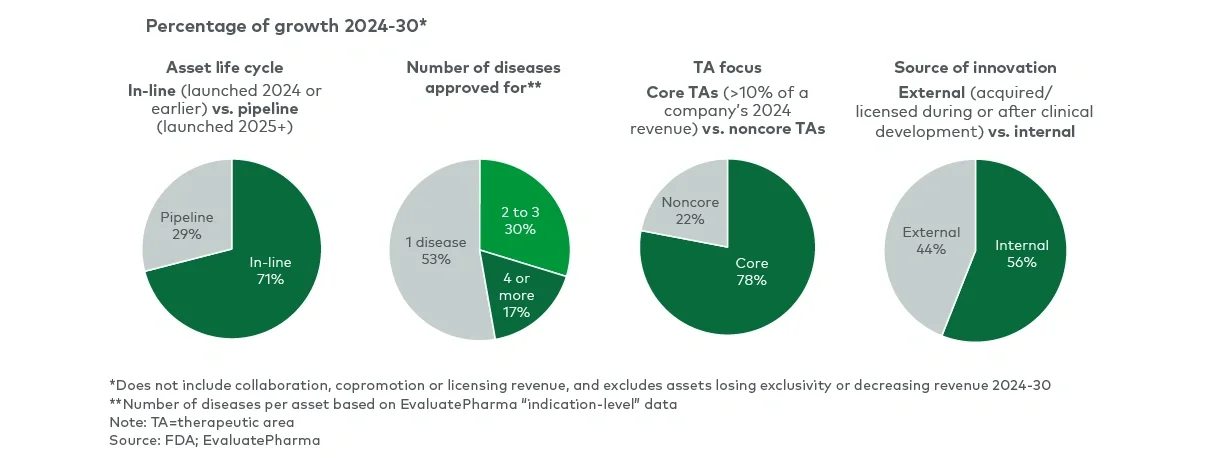
Over 70% of projected revenue growth through 2030 will come from in-line assets already on the market as of 2024 (see Figure 3). This places a premium on execution and life cycle management. To fully capture this value, companies must excel in launch performance, optimize market access and expand geographic reach. Sustained growth will depend less on new approvals and more on maximizing the potential of existing assets — ensuring they meet revenue expectations and then exceed them. 

Relying exclusively on existing products is not a viable strategy for long-term growth. Even the strongest in-line portfolios will inevitably face pressure from market saturation and LOE. To sustain momentum, companies must complement in-line growth with a consistent cadence of new product launches — not only to offset revenue decline but also to refresh the portfolio, maintain commercial relevance and reinforce investor confidence in the company’s innovation engine. 

Figure 3

Composition of top 15 biopharma 2024-30F revenue growth 

Image
Composition of top 15 biopharma 2024-30F revenue growth

Figure 3

Composition of top 15 biopharma 2024-30F revenue growth 

Image
Composition of top 15 biopharma 2024-30F revenue growth

Multidisease assets drive disproportionate value

“Portfolio-in-a-product” assets — therapies with the potential to address multiple diseases — are emerging as some of the most powerful growth drivers among the top 15 companies. Although they represent only about one-third of the combined portfolio density, these multi-indication assets are expected to account for nearly half of total projected revenue growth.  

Notably, just 13 such therapies, each spanning four or more indications, are set to deliver nearly 20% of topline expansion through 2030. Their outsize impact is a key differentiator between higher- and lower-growth players: The top five companies alone anticipate over $100 billion in growth from these assets — more than double the combined contribution expected from the bottom 10.

This underscores a critical strategic consideration. Therapies with the potential to scale across multiple diseases should be prioritized, as they offer not only greater revenue potential but also improved return on R&D and commercial investment.

Core therapeutic areas drive the majority of growth

Nearly 80% of projected revenue growth through 2030 is concentrated in core therapeutic areas — those already accounting for at least 10% of a company’s revenue.

This trend highlights the strategic advantage of building from a position of strength. By doubling down on familiar territory, companies can leverage established scientific expertise, trusted stakeholder relationships and existing commercial infrastructure to develop evidence strategies that resonate, accelerate launches, optimize access and gain share more efficiently than in less-familiar therapeutic areas.

In an environment defined by growing scientific complexity and mounting commercial pressure, companies that deepen their presence and enhance execution in core areas will be best positioned to drive consistent, capital-efficient growth.

Finding the right balance between external innovation and organic growth

External innovation — through M&A, in-licensing or strategic partnerships — remains a critical engine of growth in biopharma. Projections through 2030 show revenue growth is nearly evenly divided between internally developed assets and those sourced externally during or after clinical development. This balance does not yet reflect future deal activity, which is likely to tilt the mix even further toward external innovation over time.

This dynamic highlights a key strategic imperative: Companies must carefully balance internal R&D with external sourcing to remain competitive. Overdependence on internal pipelines can limit exposure to novel modalities and emerging science, while excessive reliance on external innovation may compress margins, introduce integration challenges and reduce long-term pipeline visibility. Striking the right balance is essential for sustained, capital-efficient growth in an increasingly complex and competitive landscape.

Key implications for pharma executives

Future growth in biopharma will depend on deliberate, insight-driven portfolio choices. The next generation of outperformers will distinguish themselves by reconfiguring their portfolios around a few core strategic principles:

  • Elevate post-launch execution and life cycle management
    Treat post-launch execution with the same strategic rigor as clinical development. Prioritize indication expansion, global market penetration and long-term value creation to fully realize the potential of in-line assets.
  • Double down on high-impact, scalable assets
    Focus investment on a select group of high-conviction programs with label expansion potential. Concentrating capital behind these assets can unlock disproportionate returns and build momentum across the portfolio.
  • Leverage strength in core therapeutic areas
    Deepen presence in therapeutic areas where scientific expertise, stakeholder relationships and commercial infrastructure already exist. Avoid the dilution and complexity that come with overdiversification into unfamiliar domains. 
  • Balance internal R&D with external innovation
    Maintain sourcing agility through a dual-engine model that combines internal research with targeted M&A, licensing and strategic partnerships. This approach ensures access to innovation across modalities and development stages while managing risk and capital efficiency.

Companies that align their commercial, development and investment strategies with these principles will be best positioned to drive sustainable, high-quality growth in an increasingly competitive environment.

For more information, please contact us.

Author’s note: Almost 50% of forecast revenue growth is attributed to the GLP-1 class. This concentration, however, does not impact the core findings and recommendations in the article.

Note: AI tools were used in the drafting of this article.

L.E.K. Consulting is a registered trademark of L.E.K. Consulting LLC. All other products and brands mentioned in this document are properties of their respective owners. © 2025 L.E.K. Consulting LLC 

Endnote
1The number of assets is not risk-adjusted for likelihood of approval 

Questions about our latest thinking?

English